Arguments that appeal to logos are commonly understood as using “logical or rational proofs that can be found by examining issues” (Crowley and Hawhee 118). But, as Crowley and Hawhee point out, the etymology of the word logos is relevent to how flexible the term is. In ancient Greek, logos referred to “voice” or “speech” (Crowley and Hawhee 118). By the Byzantine period, logos was used to mean “word,” and could sometimes convey The Word, as if spoken by God. In modern Greek, logos continues to carry these meanings things and more, including reason, excuse, oration, and sometimes even rumor. For me then, logos both conveys and performs how words can be manipulated by a rhetor to make what appear to be logical or rational arguments.
Today, we’re going to define and practice some specific methods of employing logos.
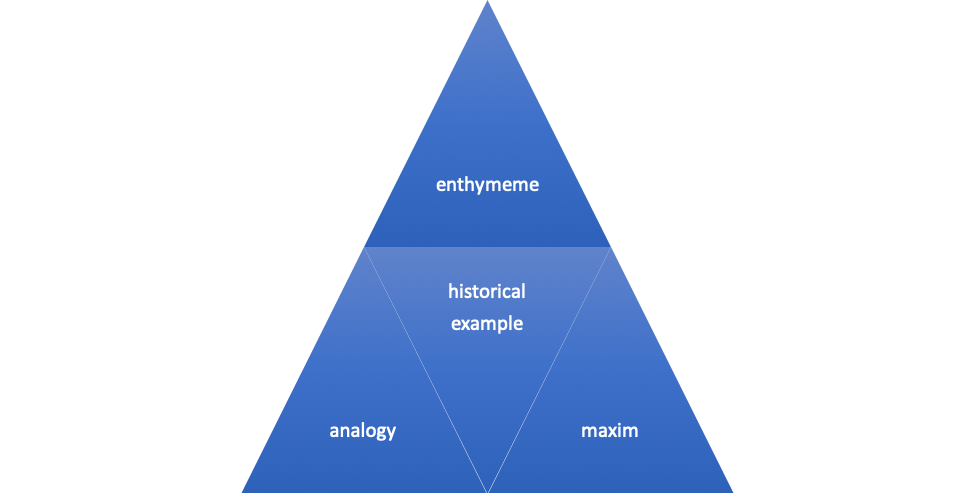
enthymemeS
Enthymemes use syllogisms, or deductive reasoning, to formulate arguments. This means that enthymemes offer premises to reach a conclusion. Here are a few examples of how to manipulate the placement of premises to create the same enthymeme:
- PREMISE + PREMISE = CONCLUSION
- If X and Y are true, then Z follows.
- Because of Z, X and Y.
Here’s what those letters can look like in words:
- Reena goes to a public elementary school in New York City that doesn’t have a dedicated fine arts program. NYC public schools are not investing in the arts!
- Because NYC public schools are not investing in the arts, Reena’s public elementary school is lacking a fine arts program.
Historical Examples
As the name suggests, historical examples compare a current phenomenon with one from the past. Here’s an example:
In the wake of the #MeToo movement in September 2018, some Americans reacted vehemently in support of Christine Blasey Ford, while others stood behind presidential Supreme Court justice nominee Brett Kavanaugh, whom Ford had accused of sexual assault. While critics of Ford argued that her case was baseless for lack of evidence and posited that any judge nominated by a president was of impeccable character, this was not the first time a Supreme Court nominee came under fire for sexual misconduct. Twenty seven years before Brett Kavanaugh was confronted by his accuser, Anita Hill testified in 1991 in hearings against Clarence Thomas, whom Hill accused of sexual harassment. Both Ford and Hill were supported by either eye witnesses or other women who claimed to have suffered assault at the hands the accused; yet in each case, divided by nearly 30 years of history, these men accused of sexual misconduct were confirmed to the Supreme Court.
Analogy
You’ve likely come across and used analogies many times in your life. “In an analogy, a rhetor places one hypothetical example beside another for the purposes of comparison” (Crowley and Hawhee 133). The result can be pleasant or effective for the audience for the way an analogy can make an unfamiliar premise feel relatable. Here’s an example:
I brace myself when crossing Hempstead Turnpike. Like the player’s avatar in Frogger, I dart into a precarious crosswalk that spans the eight lane thoroughfare hoping that traffic yields to red lights as I nervously jolt from one side of campus to another.
Maxim
Maxims are common sayings or proverbs that are familiar in the rhetor’s community. On the bottom of page 138, Crowley and Hawhee offer an effective example of how a maxim is used as form of argumentation without feeling trite.
Practice Logos
Let’s now take a look together at the “How to Major in Unicorn,” which appeared on September 4, 2019 in New York Magazine. Try to find an example of each of the above terms.
Work Cited
Crowley, Sharon, and Debra Hawhee. Ancient Rhetorics for Contemporary Students. 5th ed., Pearson Education, 2012.
Homework
WRITE Blog Post 5. Practice rhetorical methods of appealing to logos! Write an enthymeme, a historical example, an analogy, and a maxim related to the issue you’re exploring. Include sources when necessary (you’ll probably have to do this with your historical example).
READ Chapter 6 “Ethical Proofs: Arguments from Character” (146-169).

 Rhetoric 005 | History of Rhetoric | Fall 2019