A mere week has gone by since we’ve seen each other, but it still feels like a long time since we’ve sat together in Davison 017. Today, we’ll review where we’ve been and look ahead to where we’re going. Your midterm is due in a week and a half, and I want to ensure that I’ve prepared you to succeed. I’ll hand out a hardcopy of this Midterm Review sheet to work on together in class.
We will also take some time to look at my draft of your final assignment, The Persuasion Project.
HOMEWORK
READ Chapter 8 “Extrinsic Proofs: Arguments Waiting to be Used” (Crowley and Hawhee 200-221)
NOTE: I mentioned last class that you’d have until today to make up any late blog posts. You’ll see in Blackboard that I’ve graded all material you’ve handed in. If you want to make anything up, you must do so BY TONIGHT, Mon 10/21. If you have questions or concerns, please email me at andrea.r.efthymiou@hofstra.edu. I’m happy to meet with you to discuss our assignments and your progress in the course.
Pathos, in the simplest sense, is an appeal to emotion. When rhetors appeal to pathos, they are arousing emotions in their audience in an effort to be persuasive. Like appeals to ethos, pathetic appeals can affect an audience’s disposition towards a rhetor and to that rhetor’s purpose. “Aristotle realized that emotions are communal in the sense that they are usually excited by our relations with other people” (Crowley & Hawhee 175). Therefore, an accomplished rhetor will know the emotional state of their audience.
SOME METHODS OF CONSTRUCTING PATHETIC APPEALS
enargeia: when a rhetor uses details to create a vivid scene (see Crowley and Hawhee 185).
honorific: using language that honors or respects a person or topic. When this is done as an entire discourse, it’s called an encomium.
pejorative language: using language that disparages or blames someone or something. When this is done as an entire discourse, it is called an invective.
WARNING: The upcoming link directs to narratives of reporting sexual assault.
We’ll look together at a vignette from a feature story in a recent issue of New York Magazine titled “Was It Worth It?” that presents victims reflections of disclosing cases of sexual assault. Together, we’ll read Phil Saviano’s first-person account of the personal cost of coming forward as a victim of sexual assault to identify how Saviano uses pathos in his piece.
I’d like us to think together through some non-written ways (music, images, a combination of text and image) rhetors appeal to pathos.
IF WE HAVE TIME, WE’LL WORK ON OUR ETHOS HOMEWORK IN CLASS!
Homework-CLASS WILL NOT MEET ON W 10/16
INVENTING ETHOS! One way that the Ancient Greeks practiced ethopoeia was through inventing dialogue, mannerisms, and descriptions, as if composing a play, between different characters. Write a brief play where you represent the voices, language, and characteristics of two different public figures. Maybe you want Trump to talk to Obama, or Kim to chat with Kanye, or Party-Demi to talk to Awards-Show-Demi. Pick any two public figures (alive or deceased) and practice ethopoeia by writing a play where they’re in dialogue. Your play can be related to the issue you’ve been working on or not!
Successful ethopoeia will take time and offer enough details for me, as your audience, to understand your characters in some way. Consider using PATHETIC APPEALS to make your characters even more persuasive.
Post your play as Blog Post 7 by Wed, Oct. 16.
READ Chapter 8 “Extrinsic Proofs: Arguments Waiting to be Used” (Crowley and Hawhee 200-221)
Work Cited
Crowley, Sharon, and Debra Hawhee. Ancient Rhetorics for Contemporary Students. 5th ed., Pearson Education, 2012.
Ancient Greeks understood ethos as referring to the way a rhetor exhibited character (either for themselves or in representing someone else), both by individual acts and by community assessment. Crowley and Hawhee state that “ethos was not given by nature but was developed by habit” and was also dependent on a “community’s perception of [a rhetor’s or character’s] actions” (149). In other words, ethos could succeed when a rhetor demonstrates that they, or their character, are virtuous, well-informed, and understand their audience. Likewise, ethos can fail–or a rhetor can be of bad character–when their honesty is questionable, they offer faulty evidence, or they are seen to lack goodwill towards their audience.
Inventing Ethos through Ethopoeia
One way rhetors construct ethos is through ethopoeia, or literally “making” ethos through lists and definitions of behavior to establish character. Let’s listen together to about 4 minutes (3.53-7.50) of an episode of Hidden Brain, “Online Behavior, Real-Life Consequences” to understand how the host Shankar Vedantam invents ethos for William.
Although not a detailed description of another person in the way Vendantam describes William, Andrew Sullivan’s description of then-candidate Barack Obama functions as a kind of ethopoeia (153). Let’s take a look at this example and discuss how Sullivan succeeds in inventing ethos.
One way that the Ancient Greeks practiced ethopoeia was through inventing dialogue, mannerisms, and descriptions, as if composing a play, between different characters. Write a brief play where you represent the voices, language, and characteristics of two different public figures. Maybe you want Trump to talk to Obama, or Kim to chat with Kanye, or Party-Demi to talk to Awards-Show-Demi. Pick any two public figures (alive or deceased) and practice ethopoeia by writing a play where they’re in dialogue. Your play can be related to the issue you’ve been working on or not!
A successful ethopoeia will take time and offer enough details for me, as your audience, to understand your characters in some way.
Post your play as Blog Post 7 by next Wed, Oct. 16.
READChapter 7 “Pathetic Proofs: Passionate Appeals” (170-199) by next class.
Dear Wonderfully Patient, and Exceedingly Intelligent Students:
I’ve been thinking a lot about our class’s final, The Persuasion Project, and while I know I still need to write the actual assignment, I feel like I could use a bit of an exchange towards this end.
You may have intuited that I don’t know every detail about what I want from you at the end of this semester, but that doesn’t mean that I have zero expectations. On the contrary, I want you to practice persuasion in a way that can be both impactful for an audience and also exciting for you. I want you to use some of the tools I’ve introduced in this class to do that in a format that you believe is most relevant for your purpose. For this reason, I’ve designed today’s activity as a pop-up drafting workshop to consider the following:
your position as a rhetor
your audience
your purpose
what genre would be most effective to make your case
We’ll use this document to draft possibilities today, and to help you think more expansively about your topics, possible genres, and potential audiences. We’ll also take a look at work in the current issue of Jump+ to demonstrate just how expansive I want you to think.
Thanks for going with me on this journey.
Best,
Andrea
PS: Homework
TAKE A PICTURE of your completed drafting document (or if you used the electronic text, a screenshot will work) and post it to your blog by next Wednesday, 10/9.
READ Chapter 6 “Ethical Proofs: Arguments from Character” (146-169).
Arguments that appeal to logos are commonly understood as using “logical or rational proofs that can be found by examining issues” (Crowley and Hawhee 118). But, as Crowley and Hawhee point out, the etymology of the word logos is relevent to how flexible the term is. In ancient Greek, logos referred to “voice” or “speech” (Crowley and Hawhee 118). By the Byzantine period, logos was used to mean “word,” and could sometimes convey The Word, as if spoken by God. In modern Greek, logos continues to carry these meanings things and more, including reason, excuse, oration, and sometimes even rumor. For me then, logos both conveys and performs how words can be manipulated by a rhetor to make what appear to be logical or rational arguments.
Today, we’re going to define and practice some specific methods of employing logos.
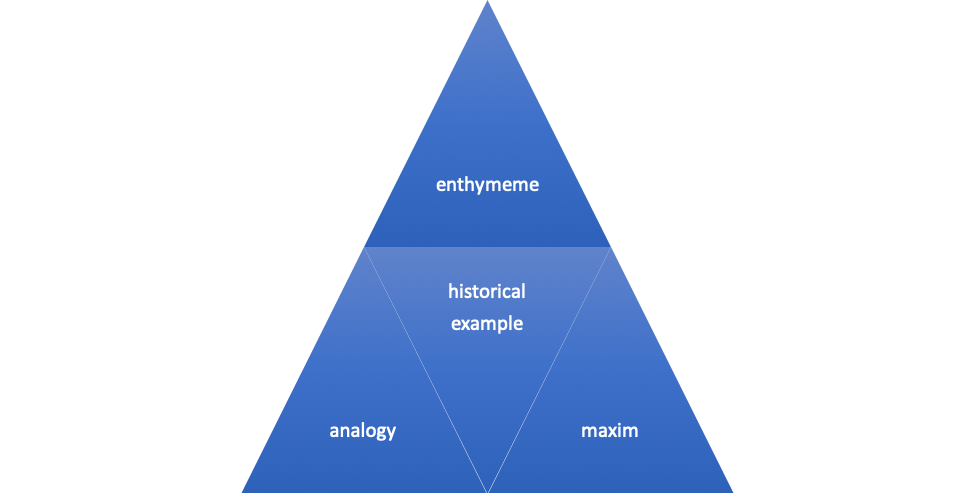
Some Methods of Reasoning in Classical Rhetoric
enthymemeS
Enthymemes use syllogisms, or deductive reasoning, to formulate arguments. This means that enthymemes offer premises to reach a conclusion. Here are a few examples of how to manipulate the placement of premises to create the same enthymeme:
PREMISE + PREMISE = CONCLUSION
If X and Y are true, then Z follows.
Because of Z, X and Y.
Here’s what those letters can look like in words:
Reena goes to a public elementary school in New York City that doesn’t have a dedicated fine arts program. NYC public schools are not investing in the arts!
Because NYC public schools are not investing in the arts, Reena’s public elementary school is lacking a fine arts program.
Historical Examples
As the name suggests, historical examples compare a current phenomenon with one from the past. Here’s an example:
In the wake of the #MeToo movement in September 2018, some Americans reacted vehemently in support of Christine Blasey Ford, while others stood behind presidential Supreme Court justice nominee Brett Kavanaugh, whom Ford had accused of sexual assault. While critics of Ford argued that her case was baseless for lack of evidence and posited that any judge nominated by a president was of impeccable character, this was not the first time a Supreme Court nominee came under fire for sexual misconduct. Twenty seven years before Brett Kavanaugh was confronted by his accuser, Anita Hill testified in 1991 in hearings against Clarence Thomas, whom Hill accused of sexual harassment. Both Ford and Hill were supported by either eye witnesses or other women who claimed to have suffered assault at the hands the accused; yet in each case, divided by nearly 30 years of history, these men accused of sexual misconduct were confirmed to the Supreme Court.
Analogy
You’ve likely come across and used analogies many times in your life. “In an analogy, a rhetor places one hypothetical example beside another for the purposes of comparison” (Crowley and Hawhee 133). The result can be pleasant or effective for the audience for the way an analogy can make an unfamiliar premise feel relatable. Here’s an example:
I brace myself when crossing Hempstead Turnpike. Like the player’s avatar in Frogger, I dart into a precarious crosswalk that spans the eight lane thoroughfare hoping that traffic yields to red lights as I nervously jolt from one side of campus to another.
Maxim
Maxims are common sayings or proverbs that are familiar in the rhetor’s community. On the bottom of page 138, Crowley and Hawhee offer an effective example of how a maxim is used as form of argumentation without feeling trite.
Practice Logos
Let’s now take a look together at the “How to Major in Unicorn,” which appeared on September 4, 2019 in New York Magazine. Try to find an example of each of the above terms.
Work Cited
Crowley, Sharon, and Debra Hawhee. Ancient Rhetorics for Contemporary Students. 5th ed., Pearson Education, 2012.
Homework
WRITE Blog Post 5. Practice rhetorical methods of appealing to logos! Write an enthymeme, a historical example, an analogy, and a maxim related to the issue you’re exploring. Include sources when necessary (you’ll probably have to do this with your historical example).
READ Chapter 6 “Ethical Proofs: Arguments from Character” (146-169).
To further consider how we’re constructing our arguments, let’s take a quick look at commonplaces, or the common ideologies that circulate within culture. Because commonplaces are context-specific, they are strongly informed by kairos and, as Quintilian noted, often somewhat hidden within the fabric of the culture. We’ll look together at how Crowley and Hawhee unpack a particular commonplace of American culture (101) and also use this short series of clips to visualize the commonplaces behind the “Drill, baby, drill” example in the textbook:
IN CLASS Writing
Starting drafting Blog Post 4!
Homework
READ Chapter 5 “Logical Proof: Reasoning in Rhetoric” (118-145) or “Without further ado, introducing logos, pathos, and ethos!!!” (giant applause)
FINISH WRITINGBLOG POST 4, which should offer the following:
Unpack the commonplaces embedded in your argument, using the Crowley and Hawhee text to support some of your claims.
Ensure that you’re identifying competing ideologies that are embedded in your issue.
Your ideas should be organized into unified paragraphs.
Cite your sources. (See my model citation below.)
This should be no less than 500 words and posted before next class on Mon, Sept. 30.
Work Cited
Crowley, Sharon, and Debra Hawhee. Ancient Rhetorics for Contemporary Students. 5th ed., Pearson Education, 2012.
We’ll build on the work you’ve been doing using kairos and stasis theory as tools for invention by adding additional tools to your repertoire: common topics and commonplaces.
Crowley and Hawhee define commonplaces as sentiments or “statements that regularly circulate within members of a community,” while topics “refer to any procedure that generates arguments” (89). Common topics operate much like stasis theory in that common topics encourage rhetors to consider conjecture (if an issue exists), degree (if an issue is better or worse than something else), and possibility (the likelihood of occurrences related to the issue at hand). We’ll begin class today by continuing the invention process you performed in groups using stasis theory to consider the common topics of degree and possibility (93-96).
In-Class Group Work
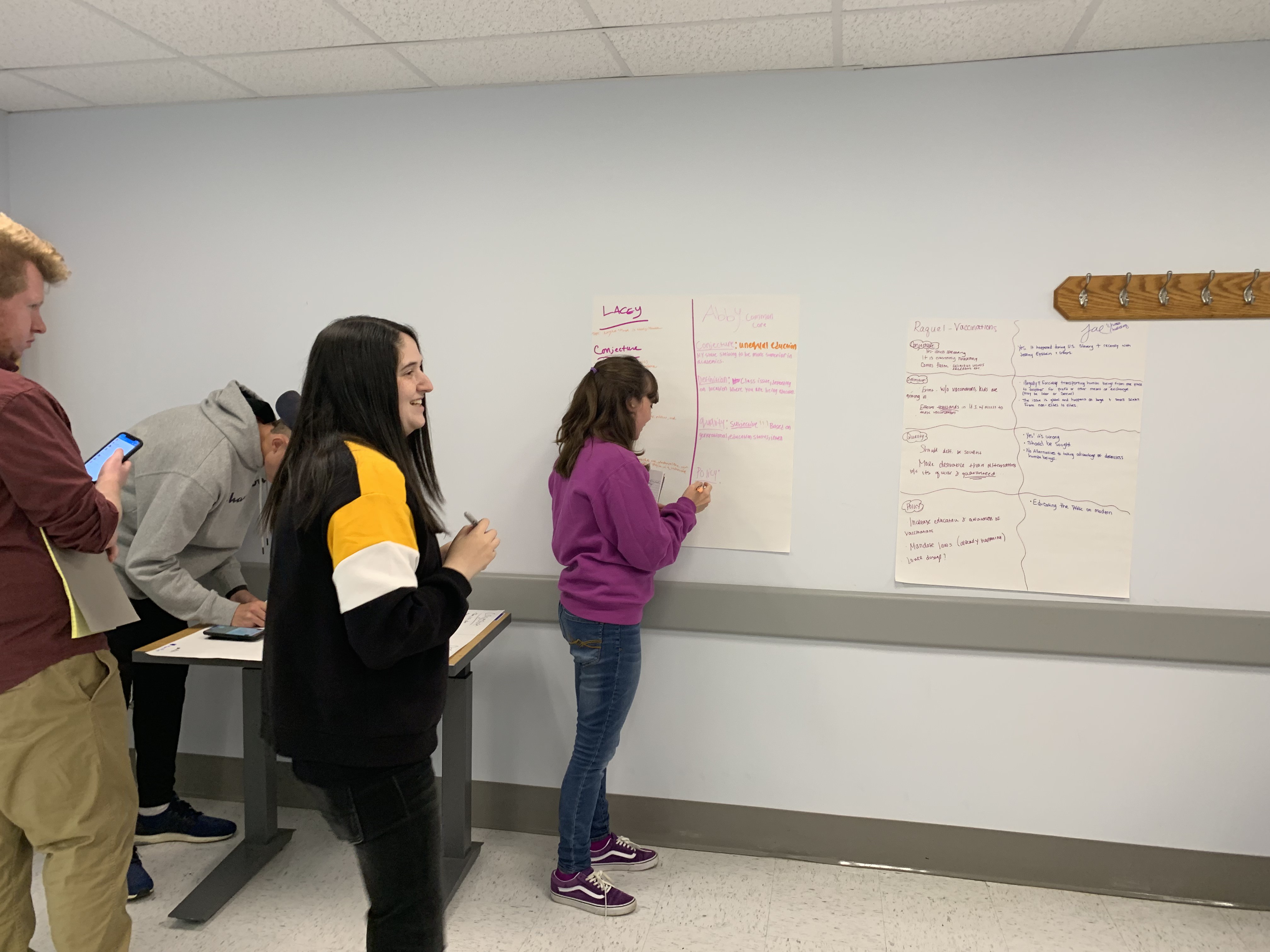
Return to your group’s poster. Using the small post-it notes, add common topics of degree and possibility to your poster, trying deliberately to invent arguments that you did not initially consider.
Homework
Review Chapter 4 “The Common Topics and the Commonplaces.” We’ll finish working in this chapter during next class.
Work Cited
Crowley, Sharon, and Debra Hawhee. Ancient Rhetorics for Contemporary Students. 5th ed., Pearson Education, 2012.
Let’s start by reviewing the fours questions of stasis AND expand them in the way Crowley and Hawhee suggest (64-72):
Conjecture: Does an issue exist? Did it happen? Is it true? Where did the issue come from? What was its cause?
Definition: What kind of thing or event is it? To what larger class of thing does this issue belong? What are its parts?
Quality: Was it right or wrong? Should it be sought or avoided? Is it more desirable than other alternatives?
Policy: What should we do? Should some action be taken? What actions are possible or desirable? How will proposed changes make things better?
REMEMBER: Moving towards stasis, using the above questions, is a tool to help rhetors invent thorough arguments. I’d like us to use the above questions of stasis when looking at one of our classmate’s second blog post. We can try to understand to what degree the post is answering each stasis question, with the goal of helping that classmate invent the most thorough argument possible.
Using Stasis to Develop Your Arguments
Working in pairs, and using the materials provided, go back to your second blog posts, re-reading them for attention to the questions of stasis. Take turns doing the following: Divide your sheet of paper into four parts: conjecture, definition, quality, and policy. Ask yourselves the questions associated with each point of stasis and write your answers to the corresponding parts.
Homework
Read Chapter 4 “The Common Topics and the Commonplaces: Finding the Available Means” (ARCS 88-117).
Research. Building on the issue you identified in Blog Post 2, use the expanded stasis questions (64-72) to develop your argument about your issue. Develop at least two propositions or points to answer each question. Write down all the propositions you can think of, even the wildest and most imaginative, even those with which you do not necessarily align yourself. You are also responsible for citing at least two sources that represent different approaches to the issue in your answers. PLEASE INCLUDE AN IMAGE OF THE WORK YOU DID IN CLASS TODAY! THIS IS DUE AS BLOG POST 3 BEFORE CLASS ON MONDAY, 9/23.
The word “argument” sometimes conjures ideas of fighting irreconcilably, where one side has to win ruthlessly to be successful, and the other side must be pummeled.
As a rhetorician, I’d like us to shift this understanding of argument to consider how argument can make meaning persuasively, presenting a careful case to help others listen, and maybe even to effect their thinking. To prepare to make a strong argument–one that will inspire someone who doesn’t necessarily agree to listen–stasis theory can help.
Using the commonly framed debate between pro-choice or pro-life positions, we’ll use “the four questions” (ARCS 63) to move towards stasis on that issue. After this collaborative exercise, you’ll work independently (or in pairs) to achieve stasis with the same four questions on the issue you identified in Blog Post 2.
Homework
Read Chapter 3 “Achieving Stasis by Asking the Right Questions” (ARCS 56-87).
Research. Building on the issue you identified in Blog Post 2, use the four questions (ARCS 63) to achieve stasis on your issue. Develop at least two propositions or arguments to answer each question. Write down all the propositions you can think of, even the wildest and most imaginative, even those with which you do not necessarily align yourself. You are also responsible for citing at least two sources that represent different approaches to the issue. THIS IS DUE AS BLOG POST 3 BEFORE CLASS NEXT MONDAY, 9/23.
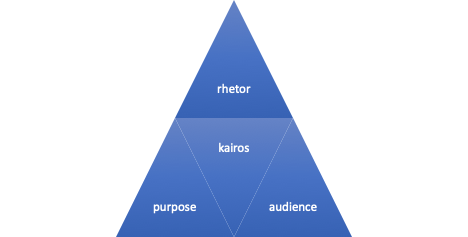
The rhetorical triangle is a tool that can help us understand any rhetorical situation. We’ll keep this tool in mind as we define kairos as a component of a rhetorical situation.
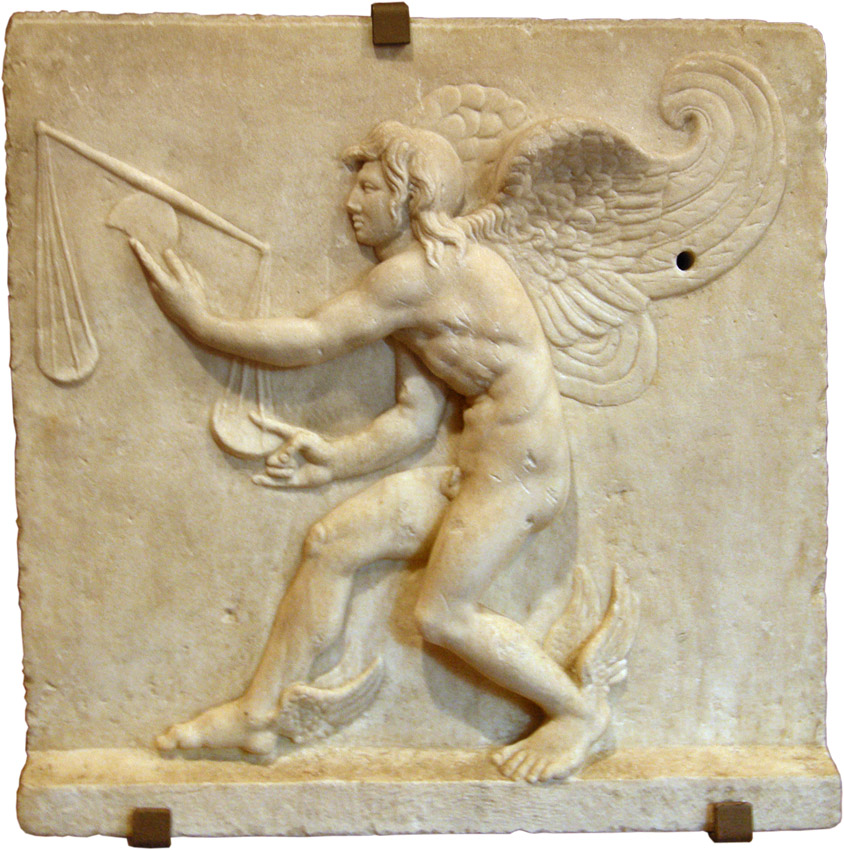
Take a look at the images representing Kairos as a mythical creature on page 39-40 in your textbook ARCS. Here’s one from a bas-relief in Turin:
Turin, Museum of Antiquities. Kairos. Marble bas-relief. Roman copy after the original by Lysippos
Together, we read the above image, and the other image in our textbook, to come up with the following qualities that define kairos:
exigence
urgency
balance (particularly in terms of time and space)
manipulation (particularly in terms of negotiating positions and points of view)
time/speed/pace
opportunity
foresight
direction/movement/momentum
hesitation & care
Kairos at Work within a Discourse
Considering our collective definition of kairos, we took a look at The Economist article “America’s Tragedy: After the Virginia Tech massacre” (ARCS 41-42) to understand how kairos is at work as a rhetorical device in this argument.
Kairos as Invention
Kairos can also be used as a tool for invention, as a way to help a rhetor find something worth writing/speaking/composing about. Turn to page 44 in ARCS and take about 5 minutes to consider the “Questions Raised by Kairos” to help you identify an issue worthy of your consideration. Write your stance on an issue you choose and use the questions to explore the issue further.
Homework
WRITE Blog Post 2 (due before next class 9/16): Develop your in-class writing today that asked you to use kairos as a tool for invention. Write 500 words (minimum) about the issue and its kairotic imperative (or its urgency). Define the issue, summarize its relevance, and identify the lines of argument–or the differing positions–that surround the issue. (In some cases, this might mean you need to demonstrate that an issue actually is urgent to consider.) You should cite at least one source in this post. We will begin next class by looking at your posts in groups!









 Rhetoric 005 | History of Rhetoric | Fall 2019