CLASS WILL NOT MEET ON MON 12/9.
In lieu of class, I’m holding extended office hours for the week of December 9-13th:
- Mon, 12/9 @ 10-11a & 1-5p
- Wed, 12/11 @ 9:30a-2:30p
- Thurs, 12/12 @ 11:30a-2:30p
- Fri, 12/13 @5-6p
CLASS WILL NOT MEET ON MON 12/9.
In lieu of class, I’m holding extended office hours for the week of December 9-13th:
You can earn up to 30 points extra credit by doing the following:
*If you’ve already completed your Persuasion Project before this event (say, because you presented your final in class), you can bring any piece of writing from another class to Cookies, Coffee, and Cramming and write about the session, BUT you’ll also have to connect the session to a rhetorical concept you learned in our class this semester!
You will bring a draft of your Persuasion Project to class on Monday, November 25.
Resources for making your final projects:
After we share the above resources, we’ll watch two TEDTalks and use our rubric to discuss how well these talks serve as models for what’s possible for us.
You will bring a draft of your Persuasion Project to class on Monday, November 25.
If you’re interested in presenting your project in class, plan to be ready to present on either December 2nd or 4th. We will schedule presentations on Mon, 11/25.

We’re taking our marks, with the semester’s finish line in the offing. To ensure that you’re prepared to hand in your final Persuasion Project by Monday, Dec 16 (note the change in due date), all in-class activities between now and the end of the semester will involve working on your projects.
Today, you’ll share your storyboards (or an alternative map) and the artifact that you brought in small groups. You will evaluate each other’s materials for:
After receiving feedback, you’ll take a couple minutes to quietly plan out your next steps alongside the final rubric for this assignment.
You will bring a draft of your Persuasion Project to class on Monday, November 25.
Let’s talk together about how we can help you get to that draft.
In today’s class, we looked at Andrew Spieldenner’s article “Statement of Ownership: An Autoethnography of Living with HIV.” I handed out hard copies of the article, which is also available through the Hofstra University Library database.
Drawing on Ellis & Bochner, Spieldenner indicates that “autoethonography combines the researcher’s self within a particular cultural context” (14). I’ve chosen to bring in Spieldenner’s text for a few reasons. I consider Spieldenner’s text an important read for the way it brings attention to the stigma of an HIV/AIDS diagnosis, but I also believe that Spieldenner’s use of autoethnography as a research method offers a model of what is possible in your own work for the Persuasion Project.
We noted in class that Spieldenner’s research-heavy early sections establish his ethos as a knowledgable rhetor and his reflective sections employ pathos to appeal to his audience. I encourage you to consider using ethnography as a way of gathering research and organizing information for your Persuasion Project.
Come ON TIME to your one-to-one conference with me next week in Mason 122. We’ll discuss your progress on the Persuasion Project based on your recent Blog Post #8.



At the heart of all the rhetorical tools we’ve learned this semester is an understanding of how rhetors communicate with audiences. When rhetors use commonplaces, extrinsic proofs, pathos, ethos, and logos, they produce some kind of effect on their audiences. So today, we’re going to spend class thinking about–really thinking about–a specific audience you will address in the Persuasion Project and what medium or genre will be most effective to convey your purpose.
NOTE that your in-class work today will be due as a blog post on Saturday, November 2.
Continue working on your Midterm, which due is as a NEW PAGE to your blog no later than midnight on Wednesday, October 30th.
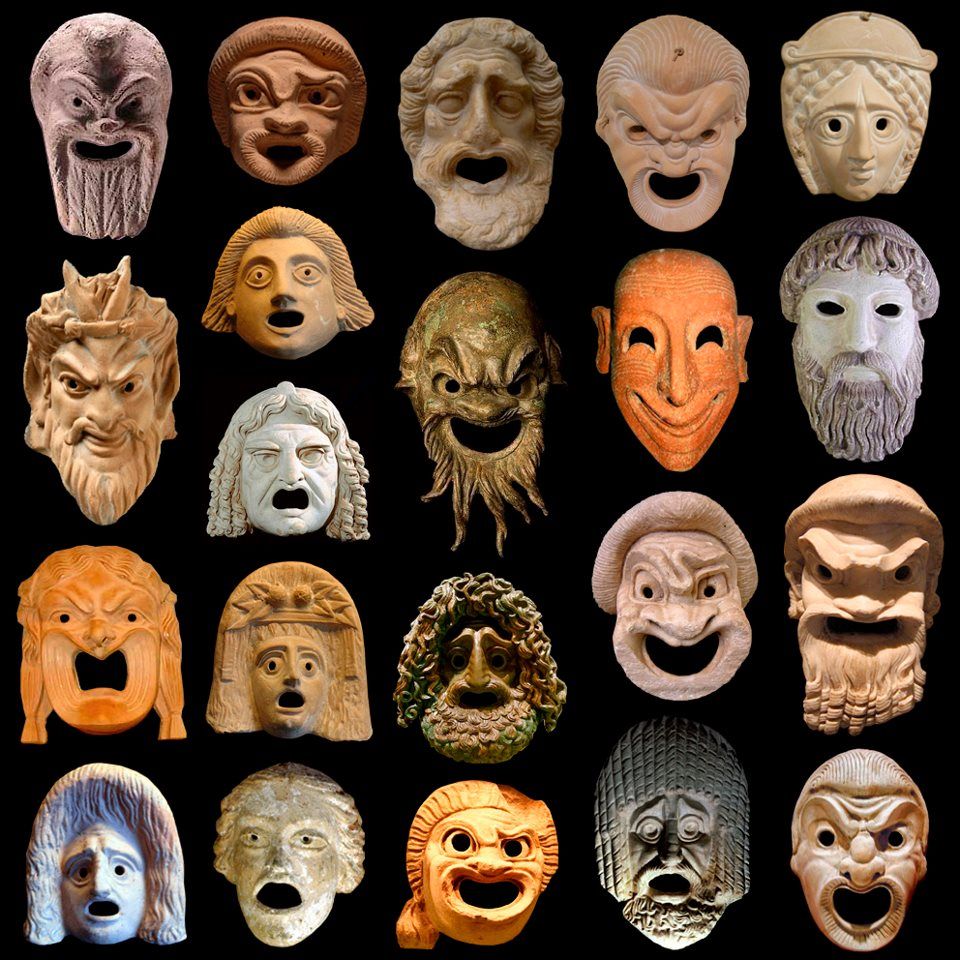
Ancient Greeks understood ethos as referring to the way a rhetor exhibited character (either for themselves or in representing someone else), both by individual acts and by community assessment. Crowley and Hawhee state that “ethos was not given by nature but was developed by habit” and was also dependent on a “community’s perception of [a rhetor’s or character’s] actions” (149). In other words, ethos could succeed when a rhetor demonstrates that they, or their character, are virtuous, well-informed, and understand their audience. Likewise, ethos can fail–or a rhetor can be of bad character–when their honesty is questionable, they offer faulty evidence, or they are seen to lack goodwill towards their audience.
One way rhetors construct ethos is through ethopoeia, or literally “making” ethos through lists and definitions of behavior to establish character. Let’s listen together to about 4 minutes (3.53-7.50) of an episode of Hidden Brain, “Online Behavior, Real-Life Consequences” to understand how the host Shankar Vedantam invents ethos for William.
Although not a detailed description of another person in the way Vendantam describes William, Andrew Sullivan’s description of then-candidate Barack Obama functions as a kind of ethopoeia (153). Let’s take a look at this example and discuss how Sullivan succeeds in inventing ethos.
If we have time, we’ll look back at Demi Lovato’s different representations of her own character to see how she uses ethopoeia in different versions of “Sorry, Not Sorry.”
One way that the Ancient Greeks practiced ethopoeia was through inventing dialogue, mannerisms, and descriptions, as if composing a play, between different characters. Write a brief play where you represent the voices, language, and characteristics of two different public figures. Maybe you want Trump to talk to Obama, or Kim to chat with Kanye, or Party-Demi to talk to Awards-Show-Demi. Pick any two public figures (alive or deceased) and practice ethopoeia by writing a play where they’re in dialogue. Your play can be related to the issue you’ve been working on or not!
A successful ethopoeia will take time and offer enough details for me, as your audience, to understand your characters in some way.
Post your play as Blog Post 7 by next Wed, Oct. 16.
READ Chapter 7 “Pathetic Proofs: Passionate Appeals” (170-199) by next class.
I’ve been thinking a lot about our class’s final, The Persuasion Project, and while I know I still need to write the actual assignment, I feel like I could use a bit of an exchange towards this end.
You may have intuited that I don’t know every detail about what I want from you at the end of this semester, but that doesn’t mean that I have zero expectations. On the contrary, I want you to practice persuasion in a way that can be both impactful for an audience and also exciting for you. I want you to use some of the tools I’ve introduced in this class to do that in a format that you believe is most relevant for your purpose. For this reason, I’ve designed today’s activity as a pop-up drafting workshop to consider the following:
We’ll use this document to draft possibilities today, and to help you think more expansively about your topics, possible genres, and potential audiences. We’ll also take a look at work in the current issue of Jump+ to demonstrate just how expansive I want you to think.
Thanks for going with me on this journey.
Best,
Andrea
TAKE A PICTURE of your completed drafting document (or if you used the electronic text, a screenshot will work) and post it to your blog by next Wednesday, 10/9.
READ Chapter 6 “Ethical Proofs: Arguments from Character” (146-169).
To further consider how we’re constructing our arguments, let’s take a quick look at commonplaces, or the common ideologies that circulate within culture. Because commonplaces are context-specific, they are strongly informed by kairos and, as Quintilian noted, often somewhat hidden within the fabric of the culture. We’ll look together at how Crowley and Hawhee unpack a particular commonplace of American culture (101) and also use this short series of clips to visualize the commonplaces behind the “Drill, baby, drill” example in the textbook:
Starting drafting Blog Post 4!
READ Chapter 5 “Logical Proof: Reasoning in Rhetoric” (118-145) or “Without further ado, introducing logos, pathos, and ethos!!!” (giant applause)
FINISH WRITING BLOG POST 4, which should offer the following:
Work Cited
Crowley, Sharon, and Debra Hawhee. Ancient Rhetorics for Contemporary Students. 5th ed., Pearson Education, 2012.
We’ll build on the work you’ve been doing using kairos and stasis theory as tools for invention by adding additional tools to your repertoire: common topics and commonplaces.
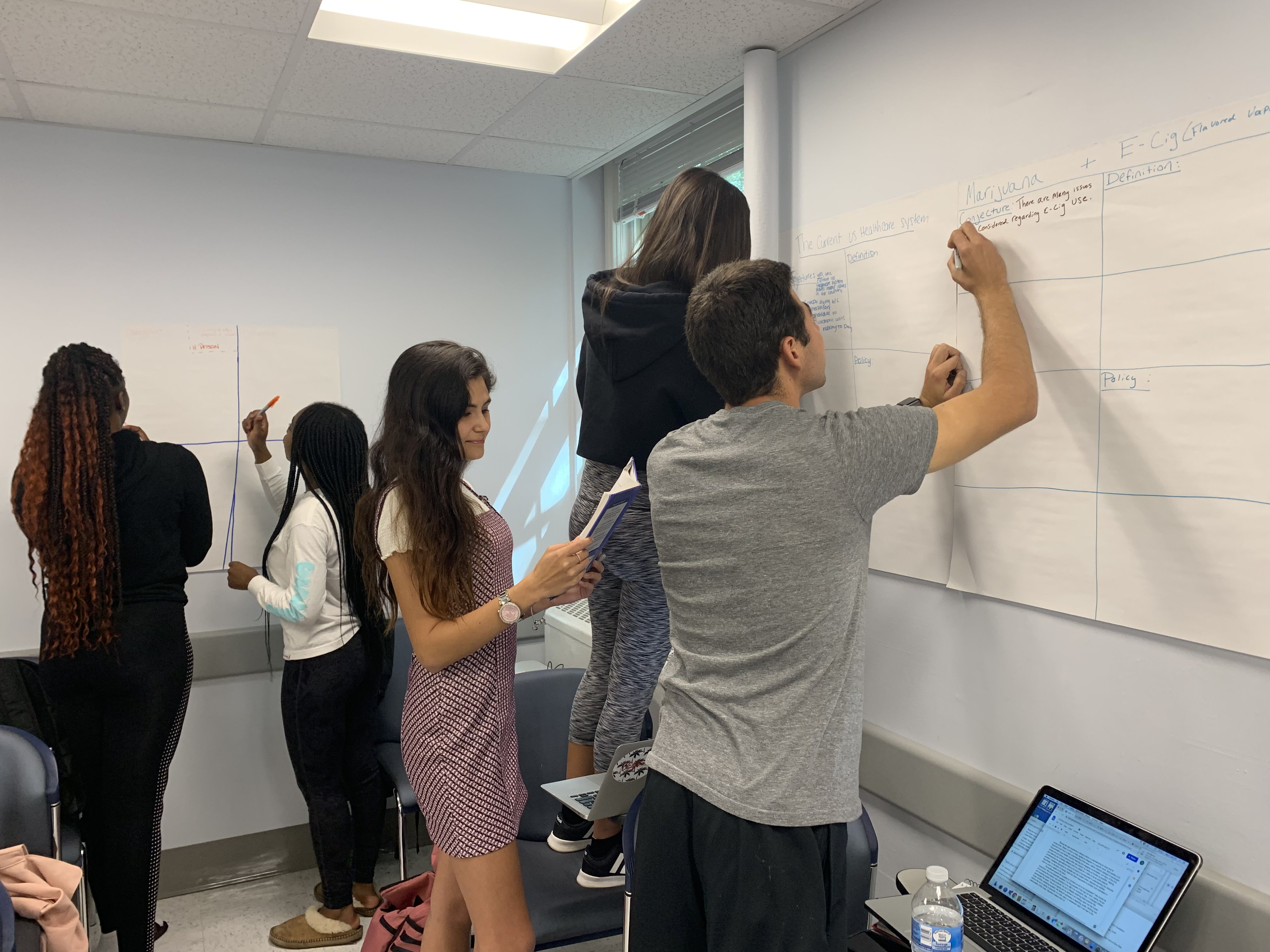
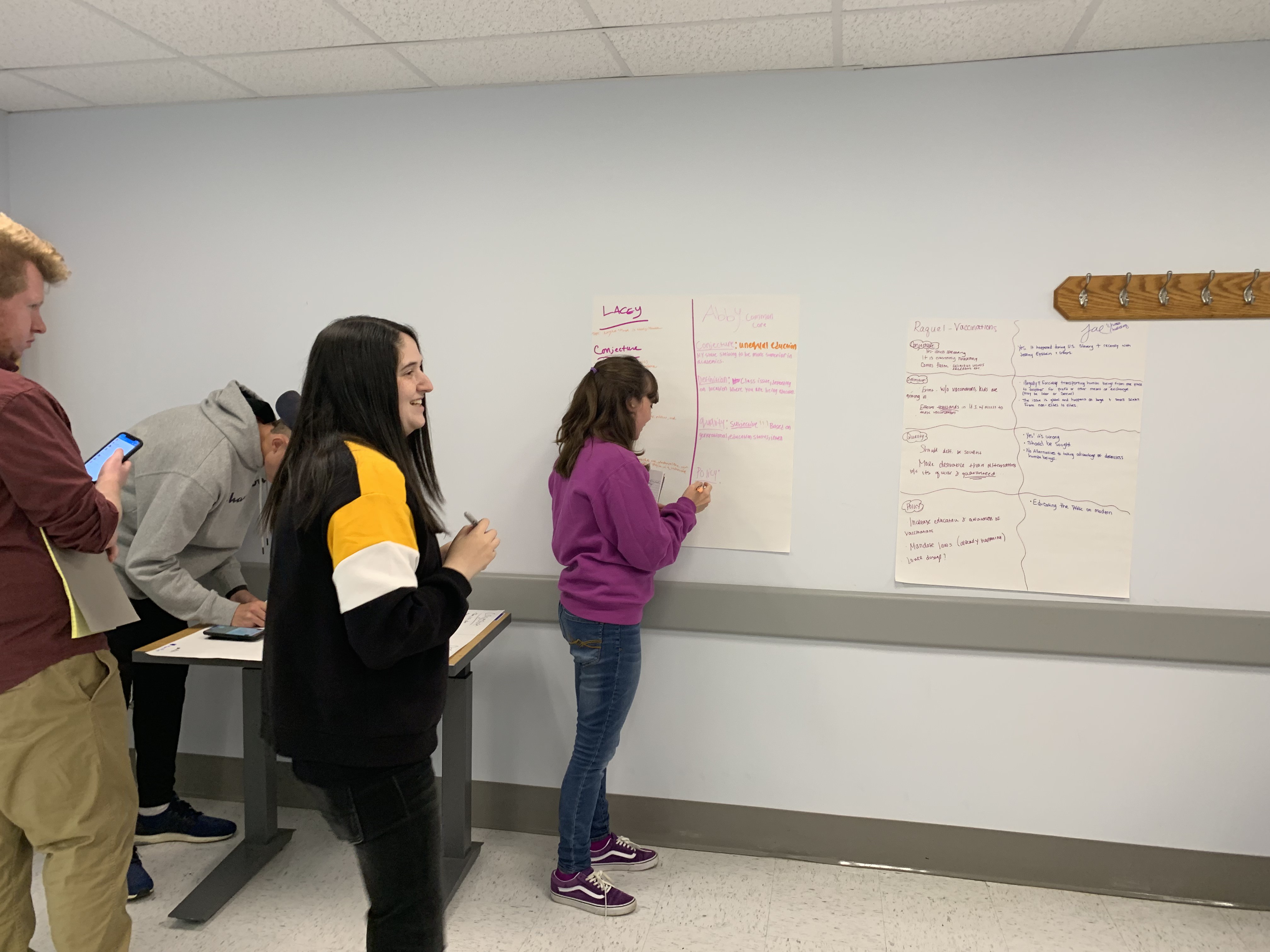
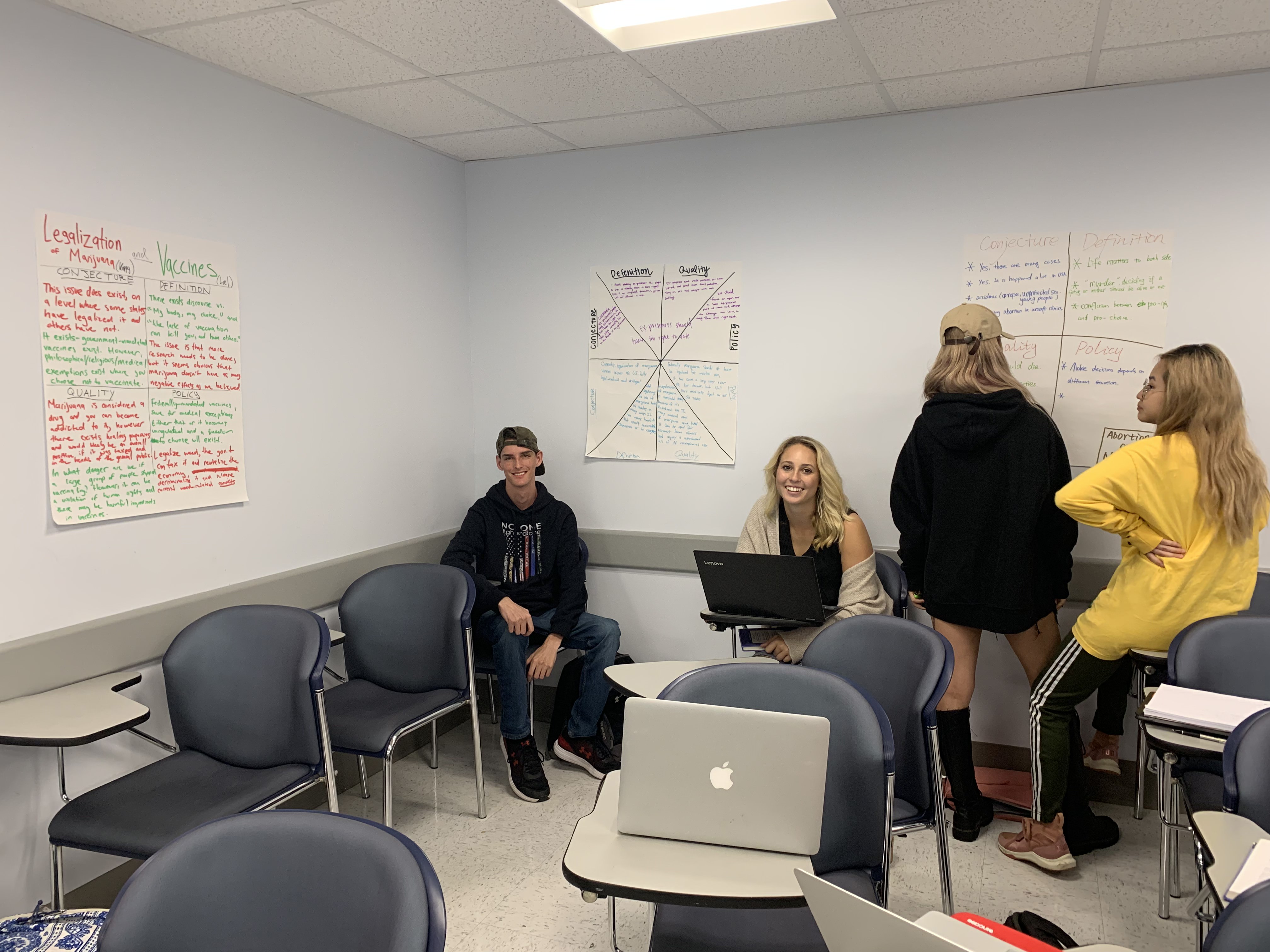
Crowley and Hawhee define commonplaces as sentiments or “statements that regularly circulate within members of a community,” while topics “refer to any procedure that generates arguments” (89). Common topics operate much like stasis theory in that common topics encourage rhetors to consider conjecture (if an issue exists), degree (if an issue is better or worse than something else), and possibility (the likelihood of occurrences related to the issue at hand). We’ll begin class today by continuing the invention process you performed in groups using stasis theory to consider the common topics of degree and possibility (93-96).
Return to your group’s poster. Using the small post-it notes, add common topics of degree and possibility to your poster, trying deliberately to invent arguments that you did not initially consider.
Review Chapter 4 “The Common Topics and the Commonplaces.” We’ll finish working in this chapter during next class.
Work Cited
Crowley, Sharon, and Debra Hawhee. Ancient Rhetorics for Contemporary Students. 5th ed., Pearson Education, 2012.
 Rhetoric 005 | History of Rhetoric | Fall 2019