Achieving Stasis: Continuing Our Rhetorical Exercise

Photo by Pixabay.com

The Four Questions of Stasis

Let’s start by reviewing the fours questions of stasis AND expand them in the way Crowley and Hawhee suggest (64-72):

  • Conjecture: Does an issue exist? Did it happen? Is it true? Where did the issue come from? What was its cause?
  • Definition: What kind of thing or event is it? To what larger class of thing does this issue belong? What are its parts?
  • Quality: Was it right or wrong? Should it be sought or avoided? Is it more desirable than other alternatives?
  • Policy: What should we do? Should some action be taken? What actions are possible or desirable? How will proposed changes make things better?

REMEMBER: Moving towards stasis, using the above questions, is a tool to help rhetors invent thorough arguments. I’d like us to use the above questions of stasis when looking at one of our classmate’s second blog post. We can try to understand to what degree the post is answering each stasis question, with the goal of helping that classmate invent the most thorough argument possible.

Using Stasis to Develop Your Arguments

Working in pairs, and using the materials provided, go back to your second blog posts, re-reading them for attention to the questions of stasis. Take turns doing the following: Divide your sheet of paper into four parts: conjecture, definition, quality, and policy. Ask yourselves the questions associated with each point of stasis and write your answers to the corresponding parts.

Homework

Read Chapter 4 “The Common Topics and the Commonplaces: Finding the Available Means” (ARCS 88-117).

Research. Building on the issue you identified in Blog Post 2, use the expanded stasis questions (64-72) to develop your argument about your issue. Develop at least two propositions or points to answer each question. Write down all the propositions you can think of, even the wildest and most imaginative, even those with which you do not necessarily align yourself. You are also responsible for citing at least two sources that represent different approaches to the issue in your answers. PLEASE INCLUDE AN IMAGE OF THE WORK YOU DID IN CLASS TODAY! THIS IS DUE AS BLOG POST 3 BEFORE CLASS ON MONDAY, 9/23.

What’s the Issue? Stasis Theory as a Tool for Inventing Arguments

The word “argument” sometimes conjures ideas of fighting irreconcilably, where one side has to win ruthlessly to be successful, and the other side must be pummeled.

Photo by Gratisography on Pexels.com

As a rhetorician, I’d like us to shift this understanding of argument to consider how argument can make meaning persuasively, presenting a careful case to help others listen, and maybe even to effect their thinking. To prepare to make a strong argument–one that will inspire someone who doesn’t necessarily agree to listen–stasis theory can help.

Work together to define stasis*

*See Chapter 3 in ARCS and add collective notes here.

Using the commonly framed debate between pro-choice or pro-life positions, we’ll use “the four questions” (ARCS 63) to move towards stasis on that issue. After this collaborative exercise, you’ll work independently (or in pairs) to achieve stasis with the same four questions on the issue you identified in Blog Post 2.

Homework

Read Chapter 3 “Achieving Stasis by Asking the Right Questions” (ARCS 56-87).

Research. Building on the issue you identified in Blog Post 2, use the four questions (ARCS 63) to achieve stasis on your issue. Develop at least two propositions or arguments to answer each question. Write down all the propositions you can think of, even the wildest and most imaginative, even those with which you do not necessarily align yourself. You are also responsible for citing at least two sources that represent different approaches to the issue. THIS IS DUE AS BLOG POST 3 BEFORE CLASS NEXT MONDAY, 9/23.

Kairos & the Rhetorical Situation

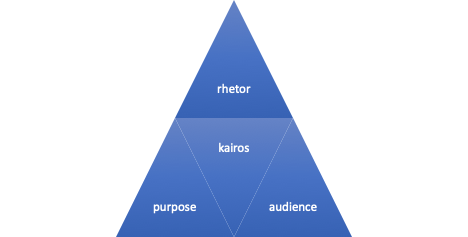
Rhetorical Triangle

The rhetorical triangle is a tool that can help us understand any rhetorical situation. We’ll keep this tool in mind as we define kairos as a component of a rhetorical situation.

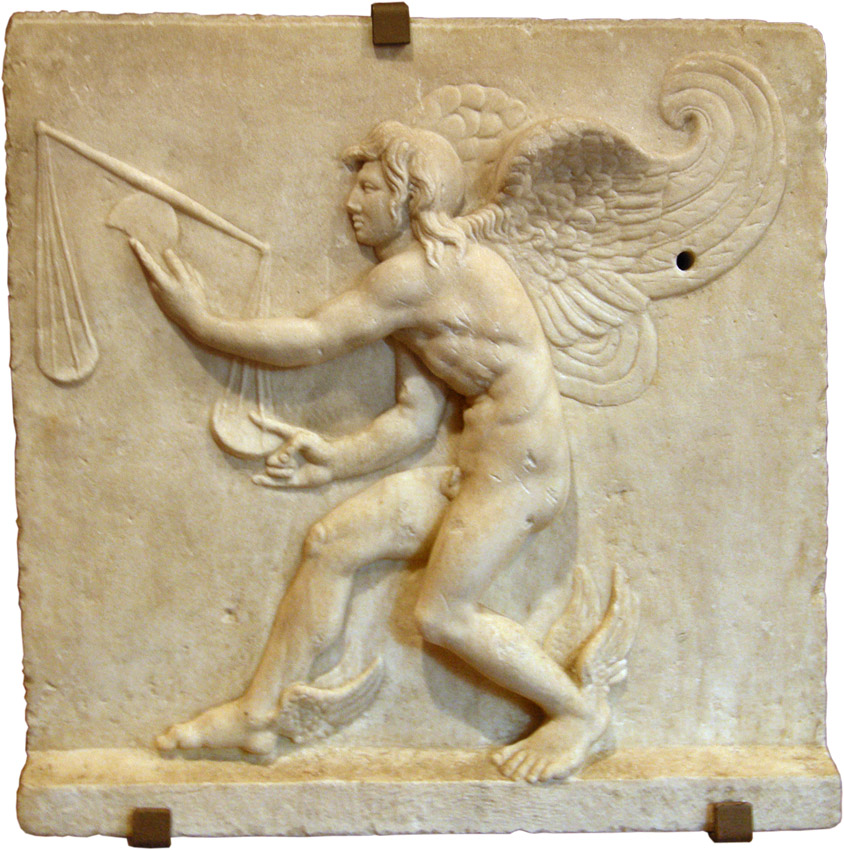
Take a look at the images representing Kairos as a mythical creature on page 39-40 in your textbook ARCS. Here’s one from a bas-relief in Turin:

Turin, Museum of Antiquities. Kairos. Marble bas-relief. Roman copy after the original by Lysippos

Together, we read the above image, and the other image in our textbook, to come up with the following qualities that define kairos:

  • exigence
  • urgency
  • balance (particularly in terms of time and space)
  • manipulation (particularly in terms of negotiating positions and points of view)
  • time/speed/pace
  • opportunity
  • foresight
  • direction/movement/momentum
  • hesitation & care

Kairos at Work within a Discourse

Considering our collective definition of kairos, we took a look at The Economist article “America’s Tragedy: After the Virginia Tech massacre” (ARCS 41-42) to understand how kairos is at work as a rhetorical device in this argument.

Kairos as Invention

Kairos can also be used as a tool for invention, as a way to help a rhetor find something worth writing/speaking/composing about. Turn to page 44 in ARCS and take about 5 minutes to consider the “Questions Raised by Kairos” to help you identify an issue worthy of your consideration. Write your stance on an issue you choose and use the questions to explore the issue further.

Homework

WRITE Blog Post 2 (due before next class 9/16): Develop your in-class writing today that asked you to use kairos as a tool for invention. Write 500 words (minimum) about the issue and its kairotic imperative (or its urgency). Define the issue, summarize its relevance, and identify the lines of argument–or the differing positions–that surround the issue. (In some cases, this might mean you need to demonstrate that an issue actually is urgent to consider.) You should cite at least one source in this post. We will begin next class by looking at your posts in groups!

READ ARCS Chapter 1 (1-36).

Opportunity for Apology?

Why not kick off our first Monday afternoon of the fall semester with a Demi Lovato video?! As you watch Lovato’s “Sorry, Not Sorry,” think about what’s going on here. Who is the rhetor (or speaker) in this situation? Who is the intended audience? What is the purpose of this video? And what is its exigence (or urgency)?

But is Demi Lovato sorry?

Culturally, this video reads as an empowering anthem. Forbes writer Hugh McIntyre claims, “For any other singer, such boasting in the face of what sounds like a former, scorned lover might be obnoxious, but the pop singer has been very vocal about her struggles with self-confidence and her own mental health, so hearing this from her in a song is truly wonderful.” In other words, Lovato demonstrates that she can remain strong in the face of cultural pressure to always appear vulnerable.

In class together, we also considered how Lovato’s purpose, audience, and even her persona as rhetor change when the entire rhetorical situation changes. Notice how the boastful and dismissive tone of her video above is revised for Lovato’s performance of the same song at the American Music Awards:

What Lovato does in “Sorry, Not Sorry” actually isn’t that new. An example of this sort of pseudo-apology in classical rhetoric is Plato’s “Apology of Socrates.”

So what is an apology when it’s not an apology? And under what conditions does the purpose of such message change from being empowering to shirking responsibility?

IN-CLASS WRITING: Think of your past experiences with apologies. When have you given, or received, an apology that felt like a sorry-not-sorry, or pseudo-apology? Who was the rhetor (or speaker) of the apology? Who was the audience? What was the purpose of this apology? And what was its exigence (or why was it urgent)? Finally, were there any other affects of the apology that you want to share?

HOMEWORK: Listen to “Apology” on the podcast Still Processing by Jenna Wortham and Wesley Morris (NOTE: this podcast aired in January 2019, so it refers to cultural events that were very contemporary at that time. Also, make sure you listen until the very last minute, because if you’re anything like me, you’ll cry.) Read Chapter 2 in Ancient Rhetorics for Contemporary Students (ARCS). Post Blog Post 1! Revise your in-class writing to be a minimum of 500 words, integrating evidence from any of the assigned texts so far (Lovato, Plato, Wortham & Morris, ARCS). I also invite you bring in other contemporary cultural examples of apologies.

Welcome to Rhetoric 005!

This course is intended to introduce you to “the study of oral and public discourse, the development of classical rhetoric, [and the] construction, dissemination, and reception of messages by audiences” (Hofstra Bulletin). As a foundation for us to build a definition of rhetoric together, I’m sharing the following premises that shape my understanding of rhetoric as a field of study:

  1. People create various discourses in response to their local and lived contexts;
  2. People can disagree with each other and often do so with reasons that feel very relevant to each individual;
  3. People create discourses because they want to affect some sort of change.

I ask you to keep these premises in mind as we move forward together to better understand the field of Rhetoric.

I’ve organized the course around the classical rhetorical concepts of invention, arrangement, style, and progymnasmata, or rhetorical exercises. Our textbook Ancient Rhetorics for Contemporary Students, by Sharon Crowley and Debra Hawhee, organizes these concepts into accessible chapters, while I will offer contemporary examples beyond the textbook to connect ancient ideas to our everyday lives. I will also regularly invite you to bring examples of discourses that circulate in your lives into our class as representations of the concepts we learn.

Learning Goals

  1. Introduce students to classical rhetorical concepts;
  2. Explore how delivery of a message—oral, written, or otherwise—impacts meaning;
  3. Understand the relationships between messages and audiences;
  4. Practice developing persuasive communication that responds to a specific context.